There’s a familiar moment in the life of many products.
A component has evolved through multiple iterations on a 3D printer, often using 3D rapid prototyping to refine geometry and fit.
The geometry works. The assembly fits. The team’s invested time and belief into refining it.
Then demand starts to increase. Quantities move from tens to hundreds, from hundreds to thousands.
At some point, someone says, “We should injection mould this.”
Technically, that’s the right direction.
But moving from 3D printing to injection moulding is far more than a change in process.
It’s a shift in risk, investment, engineering discipline, and commercial exposure.
When it’s handled properly, it delivers repeatability and scalable quality. When it’s handled casually, it locks compromise into steel.
Why A 3D-Printed Part Cannot Simply Be Injection Moulded
One of the biggest misunderstandings is the assumption that a successful printed part is simply the first version of the moulded part. In additive manufacturing, geometry dominates.
Undercuts are tolerated. Wall thickness can vary. Draft is often ignored. Tolerances are interpreted generously.
Injection moulding works differently. Polymer flows under pressure into a steel cavity, cools, shrinks, and is constrained by hardened surfaces. Every feature has direction. Every wall thickness affects cooling. Every tolerance has to be repeatable, not once, but thousands or millions of times.
The process becomes the controlling factor, not the geometry alone.
Design Refinement Before Design for Manufacture (DFM)
What’s often overlooked, though, is that even before Design for Manufacture (DFM) begins, there’s an earlier and equally important stage: design refinement.
In most organisations, product decisions are shaped by internal compromise.
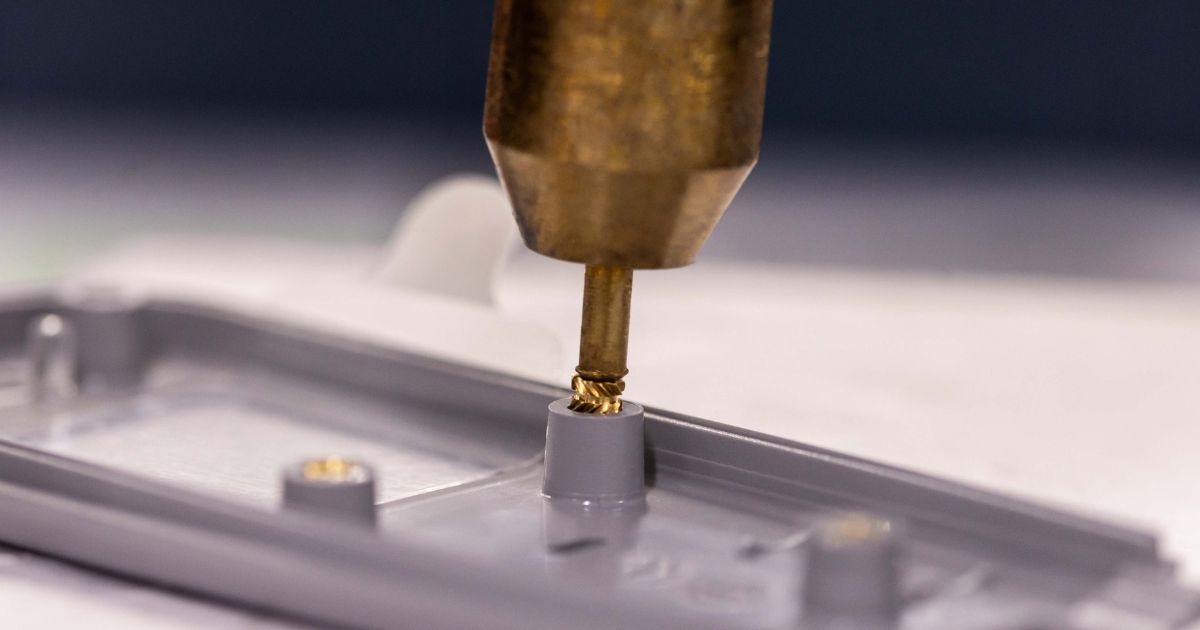
A brass insert appears because someone once insisted the part needed to be strongly fixed.
Self-tapping screws are avoided because of a past perception.
A high-performance polymer is specified because it’s seen as “the best plastic,” without anyone asking whether that level of performance is actually required.
By the time the design reaches a moulder, those debates have already happened. What arrives is the outcome of the discussion, not the discussion itself.
Part of our role is to revisit those decisions with fresh perspective before they harden into specification.
Why is that insert there? What load does it really see? Is the product disposable or serviceable? What does the business actually need this component to do?
Very often, the answers reveal opportunity.
A material costing £100 per kilo might be replaced with one at a fraction of the price. A secondary operation can disappear. A fastening method can simplify. None of that undermines the original intent. It sharpens it.
At this stage, the focus isn’t mouldability. It’s understanding the customer’s business.
We don’t expect our customers to be polymer specialists. We do expect them to understand their market, their performance requirements, and their commercial objectives.
When both sides bring their expertise to the table, the outcome improves.
What Design for Manufacture Really Means in Injection Moulding
Only once that intent is clear does true Design for Manufacture begin.
DFM asks a different set of questions. Will the geometry mould consistently? How will the plastic flow? Where will shrinkage occur? How should the tool be built to ensure stability and longevity? What tolerances are realistic at scale?
Wall thickness becomes critical. Inconsistent sections that were harmless in a printed prototype can cause warpage and sink in moulding.
Thick areas cool more slowly than thin ones, creating differential shrinkage and internal stress. Small changes to rib design or section balance can determine whether a part runs smoothly or becomes a recurring issue.
Material selection needs the same discipline.
Choosing a polymer because it feels safer or more advanced can distort the economics straight away. Under-specifying it can create performance issues later. The right decision comes from understanding the functional requirement first, then aligning the material accordingly.
Cycle Time, Tooling and the True Cost of Production
Cycle time is the primary lever.
Every second a mould remains closed, machine capacity is used.
Over tens of thousands or millions of cycles, small differences in cooling efficiency, wall optimisation or ejection design compound significantly. A part that runs in 18 seconds rather than 22 seconds may look identical on a drawing, yet commercially, the impact is substantial.
That’s why balanced wall sections, efficient cooling design and realistic tolerance expectations matter so much. They influence process stability, but they also directly influence cost per part.
But moulding time isn’t the only factor.
Designing Out Secondary Operations
Secondary operations can quickly become a hidden cost driver.
Manual insert fitting, post mould assembly, machining, printing, or additional handling all introduce labour, variability, and time.
If an insert can be overmoulded rather than pressed in later, or a feature can be designed to eliminate a secondary fixing step, the savings extend beyond labour alone.
They reduce touch points, improve consistency, and shorten lead times.
Designing out secondary operations such as insert fitting, post-mould assembly, machining, printing, or additional handling may reduce costs and improve consistency.
Designing with those downstream operations in mind is just as important as designing the mould itself.
Every additional process step adds cost and risk. Removing or integrating those steps often has a greater impact than focusing on small unit cost differences.
Sustainable cost improvement comes from engineered refinement: optimising geometry, aligning material with genuine need and designing the tool and overall process to support consistent, efficient production.
Quality, Validation and Production Stability at Scale
Quality expectations change, too.
A printed prototype might move into assembly with informal inspection. Injection moulded components, particularly in regulated environments, require structured validation and traceability.
Capability studies, defined control plans, and documented inspection methods stabilise production and protect relationships over the long term.
From Prototype Thinking to Production Thinking
Ultimately, moving from 3D printing to injection moulding isn’t about copying a shape. It’s about adopting a different mindset.
It’s a shift from prototype thinking to production thinking. From short-term iteration to long-term asset stewardship. From isolated design decisions to system-level engineering.
When design refinement and Design for Manufacture are treated as distinct but connected stages, the transition becomes far more effective.
First, make sure you’re creating the right product for the right commercial reasons. Then make sure it can be manufactured reliably and efficiently at scale.
Injection moulding rewards foresight. Steel will only ever do what you ask it to do. The real question is whether the right questions were asked before committing to it.
Involve Your Injection Moulding Partner Early
That’s why we encourage customers to involve us earlier than they might expect.
The strongest outcomes come when we’re part of the conversation while ideas are still taking shape, not once a design is already fixed.
That’s when we can ask the questions that prevent costly redesign and align performance, cost and manufacturability from the outset.
You understand your market and your product. We understand polymers, tooling and production behaviour. When those perspectives come together early, the route to production becomes clearer, faster and more robust.
If you’re considering the move from 3D printing to injection moulding, speak with our team while the thinking is still flexible.
That’s where we can make the greatest difference.
Let’s get your project moving.
Whether it’s a new project, a tool transfer, or something still taking shape, tell us what you need and we’ll connect you with the right person.