What Is Twin-Shot Moulding?

Twin-shot, or two-shot injection moulding, is an integrated process in which two different polymers are injected in a single machine cycle.
The first material is injected to form the pre-mould. The tool then rotates so a second material can be injected directly onto it.
Because the pre-mould remains within the tool throughout, the interface between the two materials is clean, strong, and highly repeatable.
Key advantages of twin-shot moulding
- Strong and clean material bonding
- Reduced variation because no handling is required between shots
- Stable and predictable cycle times
- Efficient for medium to high production volumes
- Ideal for soft touch zones, colours, seals, and functional material combinations
What Is Overmoulding?
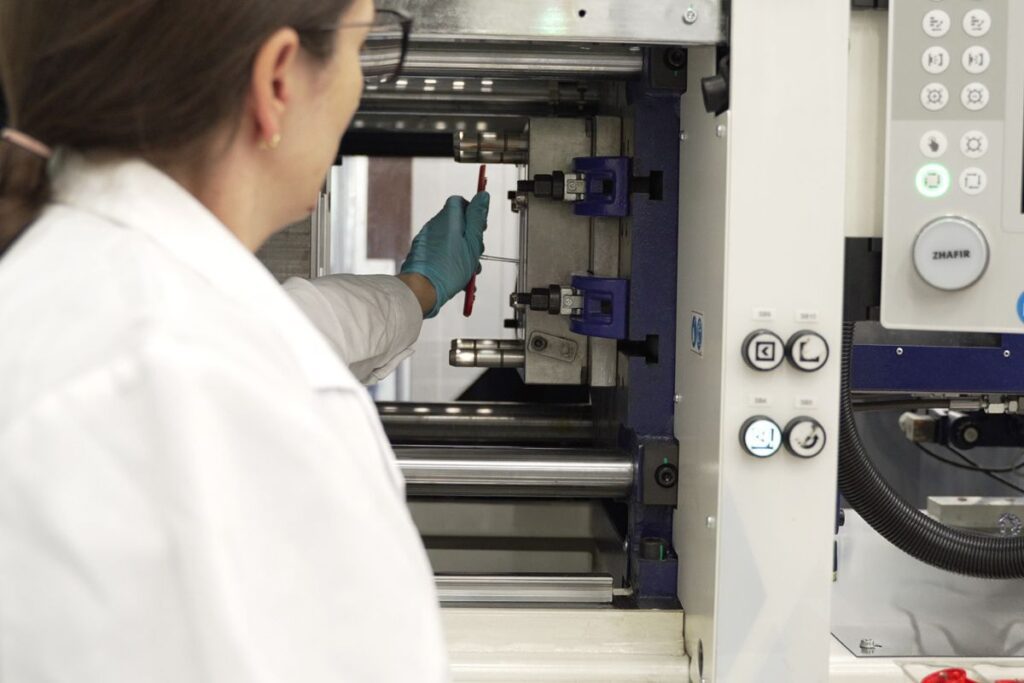
Overmoulding also combines multiple materials, but the process involves two separate stages.
The pre-mould is created first in a traditional injection moulding machine. Once cooled and ejected, it is placed into a second mould where the overmould material is injected over or around it.
Overmoulding is extremely flexible and supports both plastic-to-plastic and plastic-to-metal combinations.
Overmoulding can be completed on horizontal or vertical moulding machines, meaning it may be easier to encapsulate inserts within the mould, as gravity helps hold these parts in place.
Key advantages of overmoulding
- Lower initial tooling cost
- Greater adaptability during the development phase
- Suitable for metal inserts and hybrid assemblies
- Compatible with smaller production volumes
- Supports design iteration and material testing
- Can be performed on horizontal or vertical machines, allowing for easier loading of inserts
Key Differences Between Twin-Shot and Overmoulding
Both techniques achieve strong multi-material components.
The best choice depends on the required consistency, budget, volumes and materials involved.
1. Production route
- Twin-shot uses one tool and one machine cycle
- Overmoulding uses two stages, sometimes on two machines
2. Consistency and precision
- Twin-shot provides maximum repeatability and bond strength
- Overmoulding can introduce minor variations because the substrate is handled or robotically transferred between cycles
3. Tooling investment
- Twin-shot requires more complex tooling and machinery
- Overmoulding has a lower up-front cost and is faster to set up
4. Material compatibility
- Twin-shot typically uses two compatible thermoplastic
- Overmoulding can combine plastics, metals or composite inserts
5. Production volumes
- Twin-shot suits sustained medium to large volumes
- Overmoulding is mostly used in low volume or specialist applications, but can also be cost-effective at larger volumes
6. Flexibility
- Twin-shot is less flexible once tooled
- Overmoulding is ideal where the design may evolve
7. Bond Strength
- Twin-shot is especially effective when used to create products with integrated gaskets and seals, as the two materials are very tightly bonded.
- Overmoulding sometimes introduces small alignment or bonding challenges.
When Twin-Shot Moulding Is the Better Option
Twin-shot is often the preferred choice when production stability and long-term efficiency are essential.
Engineers typically choose twin-shot when:
- Volumes are high or predictable
- The interface between materials must be tightly controlled
- Consistency is critical to functional performance
- Multi-colour or dual polymer aesthetics are required
- Long-term cost per part needs to be optimised
Typical applications include medical housings, industrial handles, consumer electronics, and precision components where alignment or bonding quality cannot be compromised.
When Overmoulding Is the Better Option
Overmoulding offers excellent value and flexibility at early design stages or for producing smaller quantities.
Engineers typically choose overmoulding when:
- Tooling budgets are tighter at the start of the project
- Metal inserts or hybrid materials need encapsulating
- Production volumes are lower
- Material trials or iterative prototyping are required
Common applications include vibration dampers, sealed connectors, soft touch grips, clear windows, and protective housings.
How Nordell Helps Engineers Select the Right Process
Nordell supports engineering teams in evaluating both processes based on performance, material behaviour, volume expectations, and manufacturability.
Our goal is to reduce risk early, accelerate development, and deliver reliable production outcomes.
What we enable for our customers
- Reliable scaling from prototypes to full production
- Reduced risk by selecting the correct tooling route early
- Faster development through rapid prototyping and efficient tooling
- Improved product performance through informed polymer pairing
- Long-term efficiency supported by automation and real-time ERP systems
Explore Nordell’s full injection moulding services.
Is Twin-Shot Moulding Stronger Than Overmoulding?
In most cases, yes.
Twin-shot moulding typically provides a stronger bond because the two materials interface while the pre-mould is still warm and inside the tool.
However, overmoulding still achieves excellent results when:
- The materials are compatible
- Inserts are encapsulated
- Mechanical retention features are included
- The overmould area is thick enough to support bonding
What Is the Cost Difference Between the Two Processes?
Twin-shot has a higher tooling cost but a lower long-term part cost.
Overmoulding has a lower tooling cost, but higher handling or process time per part.
For projects with sustained volume, twin-shot is usually the most economical long-term solution. For lower volumes or early-stage development, overmoulding is often the best fit.
Speak to Our Engineering Team
Choosing the right multi-material moulding method at the start of the design phase can reduce cost, improve performance, and streamline production.
If you are planning a new component or refining an existing design, our team is ready to support you.
Contact our team to discuss your next project.
