Prototype tooling is a broad term used to describe mould tooling created mainly for product development, testing, validation or limited initial production.
Unlike a directly 3D-printed model, a prototype injection mould tool can produce components via injection moulding. This may allow a design to be assessed using the intended production polymer and under conditions that more closely reflect future manufacture.
The construction of a prototype tool will depend on the project. It may use a simpler design, fewer cavities or a modular insert system. Aluminium is sometimes used, but not every prototype tool is aluminium, and not every steel tool is intended for high-volume production.
Production tooling is designed and manufactured around the requirements of repeatable component manufacture over an agreed production life.
That does not mean every production tool must be hardened steel, multi-cavity or highly automated. The correct specification depends on the component design, polymer, expected volume, manufacturing cycle, tolerances and commercial objectives.
Where higher volumes are anticipated, the design of the tool becomes closely connected to the eventual cost per part.
For example, a multi-cavity tool can produce several components during each cycle, while more effective cooling may reduce cycle times. These features may require a greater initial investment but can increase capacity and reduce unit costs over the life of the programme.
The distinction between prototype and production tooling is not always absolute.
A development tool may be capable of manufacturing saleable parts, while a relatively simple production tool may be appropriate for a stable product with modest demand.
| Consideration |
Prototype tooling |
Production tooling |
| Primary purpose |
Design evaluation, testing, validation or limited manufacture |
Repeatable manufacture over the planned production life |
| Typical stage |
Product development or pre-production |
Following design approval and production planning |
| Initial investment |
Typically lower, depending on the specification |
Typically higher because the tool is designed around longer-term production |
| Lead time |
May be shorter where the tool is simpler |
May be longer because of additional engineering and validation |
| Tool life |
Specified for a limited or defined requirement |
Specified around expected volumes and operating conditions |
| Production volume |
Usually trial, low-volume or bridge production |
Usually medium- to high-volume production, although this varies |
| Design changes |
May be easier with modular inserts or simpler construction |
Changes may be more involved once the tool is completed |
| Tool materials |
May include aluminium, softer steel or steel inserts |
Often pre-hardened or hardened steel selected for the application |
| Cycle optimisation |
May not be the principal priority |
Often designed around efficient, repeatable cycles |
| Cavities |
Commonly single-cavity or limited-cavity |
May be single-cavity or multi-cavity |
| Automation |
Usually limited |
May be designed to support automated production |
| Long-term cost per part |
Can become less economical if volumes exceed the tool’s intended use |
Can provide a lower unit cost where volumes justify the investment |
These are general characteristics, not fixed definitions.
Tooling terminology can vary between manufacturers, so the construction, expected life and production capability should be clearly agreed upon rather than inferred from labels such as “prototype” or “production”.
When Is Prototype Tooling the Better Choice?
Prototype tooling is often appropriate when a component needs to be evaluated before the business commits to a full production tool.
This may be the case where:
- The design has not been fully validated
- Further dimensional or functional changes remain possible
- The intended material needs to be tested
- Only a small quantity of moulded parts is initially required
- Customer approval is needed before full production
- Commercial demand remains uncertain
- Early parts are needed before the final tool is completed
Prototype tooling can reduce the amount committed at an uncertain stage of the project. More importantly, it can help identify problems that may be expensive to correct after a full production tool has been manufactured.
However, selecting a lower-cost development tool purely to minimise the initial price can create a false economy. If demand grows quickly or the tool is used beyond its intended life, slower cycles, increased maintenance and premature wear may outweigh the original savings.
The tool should therefore be specified around a realistic development and production plan.
When Should You Invest in Production Tooling?
A project may be ready for production tooling when the design has reached an appropriate level of technical and commercial certainty.
Common indicators include:
- The component geometry is stable
- Design-for-manufacture work has been completed
- The selected polymer has been confirmed
- Fit, function and assembly requirements are understood
- Forecast demand justifies the investment
- Tolerances and surface finishes have been defined
- Repeatable production is required
- Cycle time will affect unit cost
- Formal quality or customer approval is required
A production tool should be designed around anticipated lifetime volume, rather than only the first order.
Investing in production mould tool manufacture may involve a larger upfront commitment, but a well-specified tool can support efficient cycles, repeatable quality and a lower unit cost over the planned production life.
Can Prototype or Bridge Tooling Support Production?

In some cases, yes, they can.
A prototype, development or bridge tool may be capable of producing saleable components and supporting initial or low-volume production. This can be an intentional part of the manufacturing plan rather than a temporary compromise.
Bridge tooling refers to the role a tool plays between product development and established production. It may be used:
- While a final production tool is being manufactured
- To provide initial stock for a staged launch
- While demand is being established
- Before investment in a higher-cavity tool
- While controlled design changes remain possible
- As a backup route after the main tool is introduced
Its suitability will depend on the tool material, polymer, moulding conditions, component geometry, tolerances, surface finish, required volume and acceptable cycle time.
For example, a steel insert operating within a modular bolster system may support both product development and ongoing low- to medium-volume manufacture.
Nordell’s modular tooling for low- to medium-volume production provides one possible route. A dedicated customer-owned mould insert can be used within one of Nordell’s bolster systems, avoiding the immediate need to purchase a complete standalone mould tool.
The important question is not simply whether the tool is described as a prototype, a bridge or production tooling. It is whether its construction, expected life and manufacturing performance suit the intended programme.
Aluminium vs Steel Mould Tooling
Aluminium and steel tooling are sometimes presented as a simple choice between prototyping and production. In practice, the decision is more nuanced.
Aluminium is easier to machine than many tool steels and can offer efficient heat transfer. These characteristics may help reduce tooling lead times and support effective cooling in suitable applications.
However, aluminium is generally softer and more susceptible to wear or damage. Its suitability will depend on the required volume, component geometry, polymer and surface finish.
Steel tooling may provide greater wear resistance and a longer operating life. Different grades and heat treatments can be selected according to the demands of the application. Steel may be particularly important when processing abrasive or reinforced materials, maintaining demanding surface finishes or supporting extended production.
The choice should take into account:
- Expected lifetime volume
- Polymer type
- Abrasive or glass-filled content
- Part complexity
- Tolerances
- Surface finish
- Cooling requirements
- Maintenance
- Likelihood of future changes
Aluminium does not automatically mean prototype, just as steel does not automatically mean production. The material should be selected around the project’s technical and commercial requirements.
How Does Production Volume Affect the Decision?
Production volume is one of the most important considerations, but annual demand alone does not provide the complete picture.
A tooling partner will also need to understand the first-order volume, expected lifetime volume, delivery frequency, peak demand, available moulding capacity, and potential for future growth.
A single-cavity tool produces one component during each moulding cycle. A multi-cavity tool can produce several, potentially increasing output and reducing the moulding cost per part.
However, increasing the number of cavities usually makes the tool larger, more complex and expensive. It can also place greater demands on filling, cooling, ejection and process control.
For lower-volume products, a single-cavity or modular tool may provide a more sensible commercial route. For a higher-volume programme, the additional investment in multiple cavities and cycle-time optimisation is usually recovered through lower production costs.
There is no universal volume at which one route becomes correct. The decision should be based on the component, manufacturing process and total programme economics. We can help you decide this.
Other Factors to Consider Before Choosing a Tooling Route
Component Design and Plastic Material
Features such as undercuts, threads, ribs, bosses and side actions can increase tooling complexity. Wall thickness and transitions between thick and thin sections also affect how the polymer fills and cools.
Poorly considered geometry can contribute to sink marks, warpage, incomplete filling or extended cycle times. A design-for-manufacture review can identify these risks before the tool is commissioned.
The intended polymer also has a direct bearing on the tooling specification. Processing temperatures, shrinkage, flow behaviour and cooling requirements differ between materials. Abrasive fillers, such as glass fibres, can increase wear on cavities, cores and feed systems.
Testing the intended material can therefore be one of the main reasons for using prototype injection mould tooling rather than relying solely on a 3D-printed model.
Tolerances, Surface Finish and Future Changes
Tight tolerances may require greater precision in tool manufacture, more controlled moulding conditions and detailed inspection during validation.
Visible components may also require polishing, texturing or careful control of gate and ejector locations. These requirements should be established early, as they can influence both tool design and cost.
Where further design changes are likely, replaceable inserts or modular tooling may make selected alterations easier to implement. Changing a small insert can be more practical than modifying a completed cavity, although not every feature can be isolated in this way.
Quality, Validation and Launch Timing
The required validation will depend on the product, customer, and sector.
A project may involve tool trials, dimensional inspection, first-off samples, material certification or formal production approval. Some customers may also require documentation for the Production Part Approval Process (PPAP).
These requirements should be established before tooling begins.
Lead time also matters, particularly where launch deadlines have been agreed. However, the fastest initial option is not automatically the most efficient overall. A tool that cannot meet later demand may lead to a second tooling investment, duplicated validation and disruption during scale-up.
Tool Ownership and Maintenance
Before commissioning a mould tool, the customer should understand:
- Who will own it
- Where it will be operated and stored
- Who is responsible for servicing
- How repairs and modifications will be managed
- What happens if production is transferred
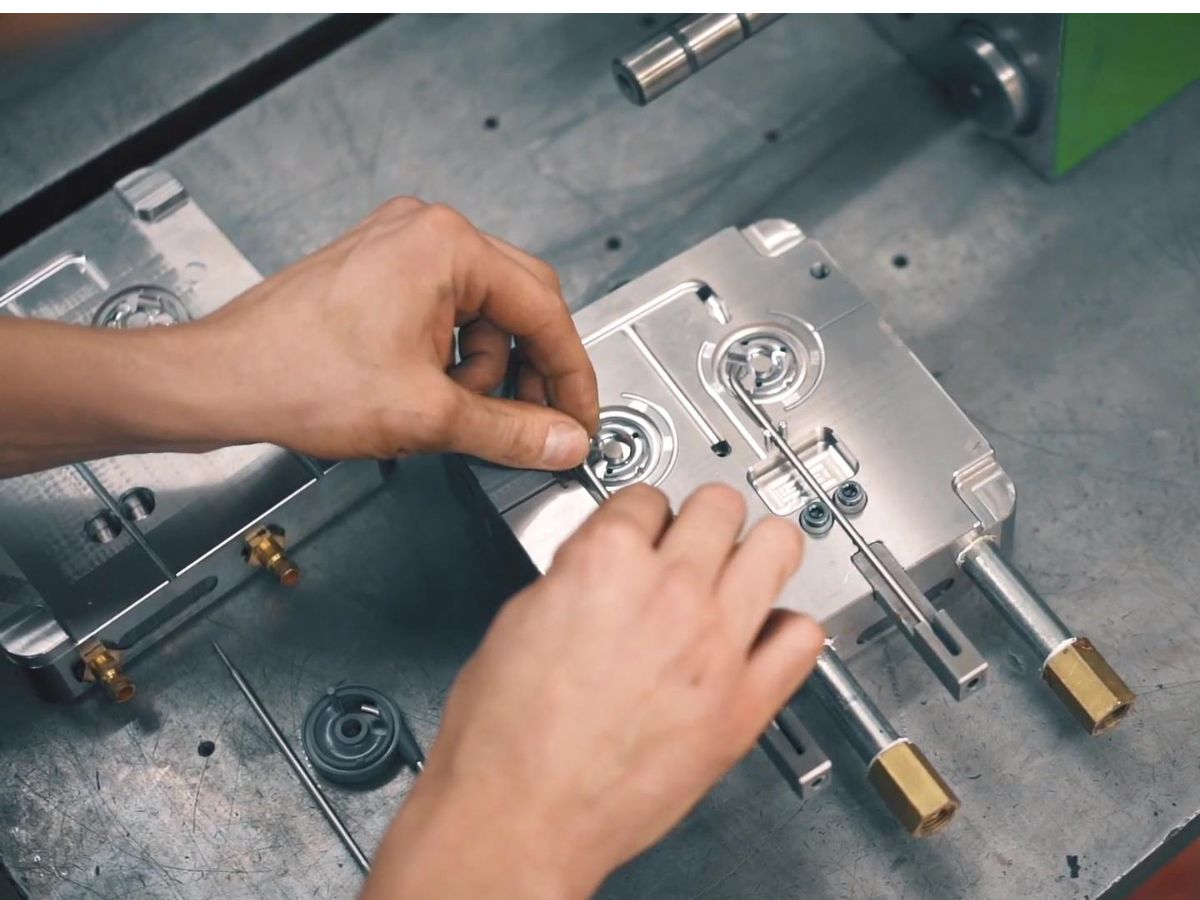
Preventative mould tool maintenance and servicing can help protect critical surfaces and components, reduce unplanned downtime and preserve consistent part quality throughout the tool’s working life.
Should You Move Directly to Production Tooling?
Prototype tooling is not a compulsory stage in every injection moulding project.
Moving directly to production tooling may be appropriate where:
- The design is based on a proven component
- Sufficient testing has already been completed
- Demand is reasonably certain
- The selected polymer is established
- Design-for-manufacture work is complete
- An additional development tool would provide limited value
- The production tool can incorporate suitable replaceable inserts
- It is a re-tool of an existing part
Conversely, moving directly to production tooling may create unnecessary risk where the design remains uncertain, the material has not been tested, or significant revisions are still likely.
The value of prototype tooling should therefore be judged by the risk it removes. If it answers important technical or commercial questions before the larger investment is made, it may be worthwhile. If those questions have already been answered, proceeding directly to production tooling may be more efficient.
How Nordell Helps Customers Choose the Right Tooling Route
The right tooling decision begins with understanding the complete manufacturing requirement rather than selecting a tool based on price alone.
Nordell can support customers from early product development through to tooling, injection moulding and ongoing production.
Depending on the project, this may include:
- Reviewing the component design and application
- Providing design-for-manufacture guidance
- Producing 3D-printed prototypes
- Considering modular or full production tooling
- Advising on tool materials and cavity numbers
- Reviewing runner, gate, cooling and ejection requirements
- Manufacturing tools in the UK or through Nordell’s Xiamen facility
- Carrying out tool trials and dimensional inspection
- Supporting PPAP requirements where applicable
- Manufacturing the injection-moulded components
- Maintaining, servicing and modifying tooling during production
- Material consultancy
- Component sourcing
The most appropriate manufacturing route will depend on cost, timescale, complexity, validation requirements and the wider production programme.
Questions to Ask Before Commissioning an Injection Mould Tool
Before choosing between prototype, modular and full production tooling, consider:
- Is the component design final?
- Has it been reviewed for injection moulding?
- Which polymer will be used?
- What are the initial, annual and lifetime volumes?
- What tolerances and surface finishes are required?
- Are inspection or approval documents needed?
- Are future design revisions likely?
- How quickly are the first moulded parts required?
- Could the initial tool later serve as a backup?
- Who will own, store and maintain the tool?
The answers will help determine the type of tool required, the number of cavities, the construction material, the validation process and the long-term production strategy.
Speak to Nordell About Your Injection Mould Tooling Project
There is no universally correct choice between prototype and production tooling.
A development or modular tool may provide the right balance where the design needs to be validated, demand remains uncertain or low- to medium-volume production is required. A full production tool may offer better long-term value where the component is proven and repeatable manufacture is needed at a greater scale.
The decision should account for the design’s maturity, the selected polymer, technical requirements, anticipated tool life, and total production volume.
Speak to Nordell about your component, tooling requirements and production forecasts. Our technical team can help you evaluate available routes and develop a tooling strategy that aligns with both your immediate needs and longer-term manufacturing plans.
